Whether responding to a high-profile Freedom of Information Act (FOIA) request, satisfying a strict litigation discovery deadline, or releasing public records under legislative mandates, organizations face a double-edged sword: uncompromising statutory deadlines on one side, and relentless public scrutiny on the other.
When document volume scales up rapidly, operational speed often becomes the primary objective. But in the rush to meet disclosure timelines, a dangerous compromise frequently occurs.
Speed is accelerated, but security is sacrificed.
The True Weight of Public Scrutiny
Public disclosures carry zero margin for error. In a climate where journalists, opposing counsel, and regulatory auditors possess advanced digital tools, a document released to the public isn’t just read-it is audited down to its raw binary code.
When administrative teams are forced to process thousands of pages under tight deadlines, standard workflows break down:
- Manual Review Fatigue: Human reviewers missing sensitive personal identifiable information (PII) as page counts multiply.
- Surface-Level Blackouts: Relying on basic markup tools that visually cover text on screen while leaving the underlying data payload intact.
- Metadata Residue: Leaving hidden author profiles, revision histories, and structural XML tags embedded in published files.
Under public scrutiny, a “99% success rate” isn’t a pass mark-it is a 100% liability. A single overlooked social security number, trade secret, or internal comment can trigger catastrophic regulatory fines and public backlash.
The High Volume Trap: Why Linear Workflows Fail
Most organizations attempt to solve volume surges by throwing more human hours or basic office software at the problem. However, manual and cosmetic workflows scale linearly-meaning as page volume doubles, your risk of human error doubles alongside it.
True operational sovereignty requires moving away from manual “box-drawing” toward automated forensic de-identification.
When volume spikes, maintaining absolute boundary control depends on three non-negotiable standards:
- Structural Flattening: Stripping away all hidden document layers, version histories, and embedded objects so that raw code cannot be recovered.
- Zero Metadata Residue: Completely purging unseen file properties and system tags before the document leaves your environment.
- Audit-Ready Compliance: Creating a verifiable, permanent record of de-identification that satisfies the strictest statutory guidelines.
Achieving True Operational Independence
Processing public records requests under statutory pressures shouldn’t feel like a high-wire act. Your organization shouldn’t have to choose between missing a legal deadline or exposing sensitive data to the world.
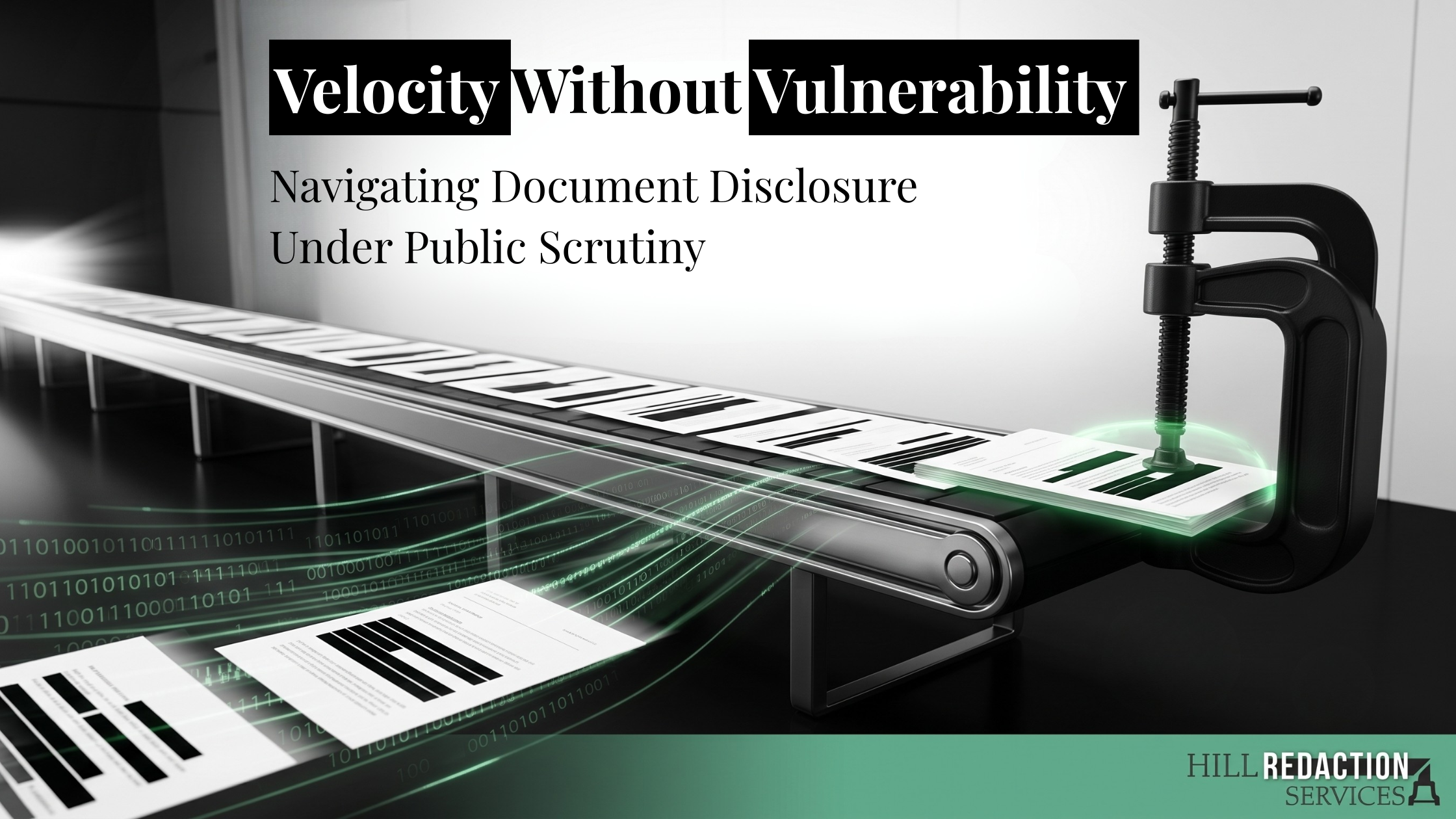
By replacing surface masking with deep-level forensic workflows, enterprise and public sector teams achieve what was once thought impossible: maximum processing velocity with zero structural vulnerability.
Don’t let the weight of public scrutiny compromise your perimeter.
Is high document volume putting your disclosure workflows at risk?
At Hill Redaction Services, our forensic de-identification engine allows organizations to process massive document volumes under tight deadlines with complete compliance certainty.
Related Posts
Whether responding to a high-profile Freedom of Information Act (FOIA) request, satisfying a strict litigation discovery deadline, or releasing public records under legislative mandates, organizations face a double-edged sword: uncompromising statutory deadlines on one side, and relentless public scrutiny on the other.
When document volume scales up rapidly, operational speed often becomes the primary objective. But in the rush to meet disclosure timelines, a dangerous compromise frequently occurs.
Speed is accelerated, but security is sacrificed.
The True Weight of Public Scrutiny
Public disclosures carry zero margin for error. In a climate where journalists, opposing counsel, and regulatory auditors possess advanced digital tools, a document released to the public isn’t just read-it is audited down to its raw binary code.
When administrative teams are forced to process thousands of pages under tight deadlines, standard workflows break down:
- Manual Review Fatigue: Human reviewers missing sensitive personal identifiable information (PII) as page counts multiply.
- Surface-Level Blackouts: Relying on basic markup tools that visually cover text on screen while leaving the underlying data payload intact.
- Metadata Residue: Leaving hidden author profiles, revision histories, and structural XML tags embedded in published files.
Under public scrutiny, a “99% success rate” isn’t a pass mark-it is a 100% liability. A single overlooked social security number, trade secret, or internal comment can trigger catastrophic regulatory fines and public backlash.
The High Volume Trap: Why Linear Workflows Fail
Most organizations attempt to solve volume surges by throwing more human hours or basic office software at the problem. However, manual and cosmetic workflows scale linearly-meaning as page volume doubles, your risk of human error doubles alongside it.
True operational sovereignty requires moving away from manual “box-drawing” toward automated forensic de-identification.
When volume spikes, maintaining absolute boundary control depends on three non-negotiable standards:
- Structural Flattening: Stripping away all hidden document layers, version histories, and embedded objects so that raw code cannot be recovered.
- Zero Metadata Residue: Completely purging unseen file properties and system tags before the document leaves your environment.
- Audit-Ready Compliance: Creating a verifiable, permanent record of de-identification that satisfies the strictest statutory guidelines.
Achieving True Operational Independence
Processing public records requests under statutory pressures shouldn’t feel like a high-wire act. Your organization shouldn’t have to choose between missing a legal deadline or exposing sensitive data to the world.
By replacing surface masking with deep-level forensic workflows, enterprise and public sector teams achieve what was once thought impossible: maximum processing velocity with zero structural vulnerability.
Don’t let the weight of public scrutiny compromise your perimeter.
Is high document volume putting your disclosure workflows at risk?
At Hill Redaction Services, our forensic de-identification engine allows organizations to process massive document volumes under tight deadlines with complete compliance certainty.