In public records compliance, a document is never a solitary island. During high-volume spring cycles, agencies face a structural vulnerability: the Mosaic Effect. This happens when separate, seemingly secure disclosures are aggregated by outside actors to piece together a protected identity. When your redaction strategy focuses purely on individual pages rather than the cumulative landscape, you are inadvertently building an identity’s blueprint.
The Danger of Linear Review
High-volume queues force public records offices into a dangerous compromise: velocity versus precision. When compliance workflows focus entirely on clearing the backlog, reviews become linear. Officers examine Document A, apply a mask, and move to Document B. This file-by-file insularity is precisely where systemic exposure begins.
The Mosaic Effect completely bypasses direct identifiers like Social Security numbers. Instead, it exploits the relationship between seemingly benign fragments left exposed across separate releases:
- Document A discloses a precise date of an incident.
- Document B unmasks a localized ZIP code.
- Document C leaves a rare job title unredacted.
To a standard review program, each document appears safely anonymized. But to an actor collecting these files over months, these individual disclosures function like tile fragments in a mosaic. When overlaid, the patterns connect and an undeniable identity fingerprint emerges.
The Illusion of the Digital Mask
Many organizations rely on software that treats redaction as a surface-level event—simply applying a visual block over text.
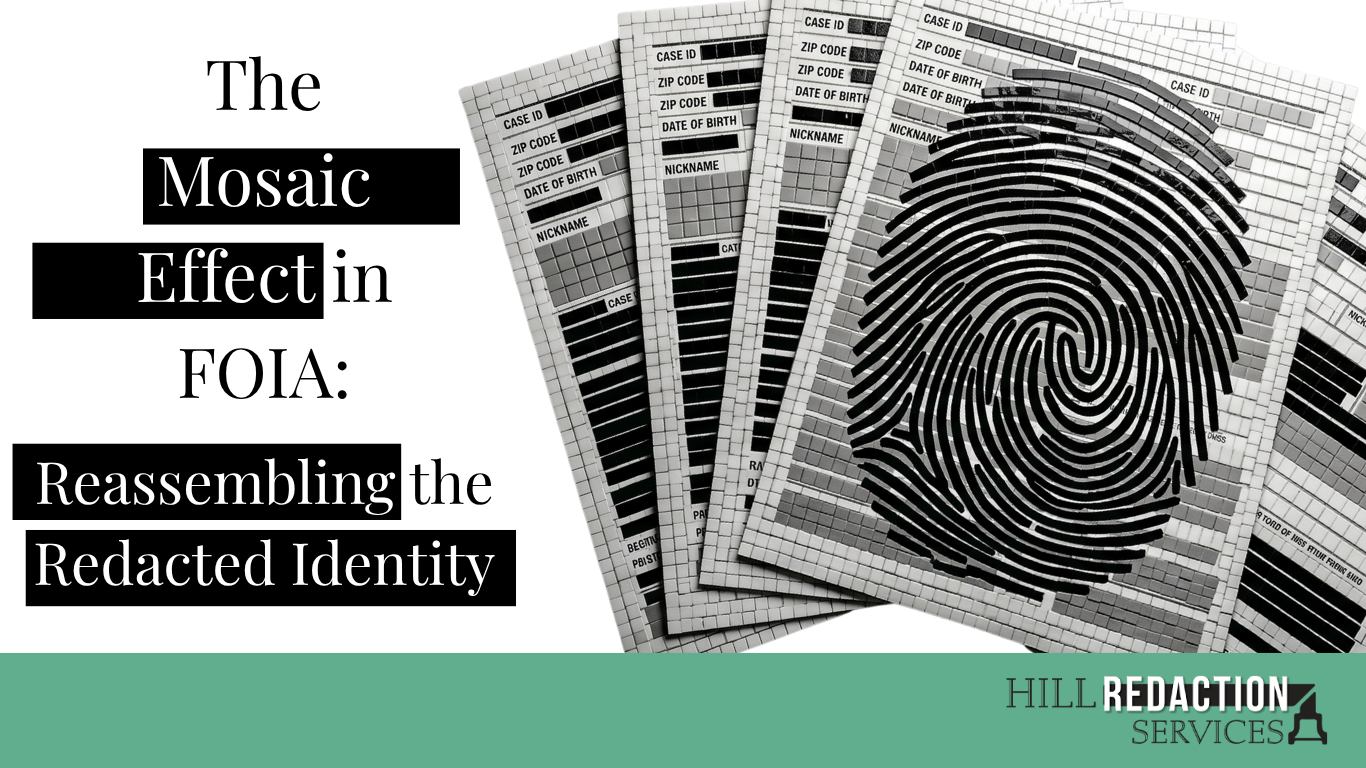
As the accompanying graphic illustrates, traditional redactions can actually outline the very shape they attempt to conceal. If the underlying data structure isn’t forensically scrubbed, the remaining text blocks, metadata trails, and contextual alignment form a rigid grid. This grid acts as a guide, allowing external database matching tools to effortlessly fill in the blanks.
Shifting to Forensic Removal
To secure public trust without choking transparency, compliance officers must transition from linear text-blocking to Forensic Data Removal through two critical adjustments:
- Contextual Evaluation: Reviewing records with an analytical awareness of prior disclosures. If a fragment can cross-reference an existing public data point to reveal a profile, it must be removed.
- Bitstream Re-Sequencing: Ensuring that once data is redacted, the code beneath it is structurally destroyed and re-compiled. There must be no digital crumbs or metadata remnants left to serve as puzzle pieces.
High-volume public transparency requires looking at the cumulative picture of your data, not just single documents. True compliance means recognizing that what you disclose today can be weaponized to unmask what you protected yesterday.
Related Posts
In public records compliance, a document is never a solitary island. During high-volume spring cycles, agencies face a structural vulnerability: the Mosaic Effect. This happens when separate, seemingly secure disclosures are aggregated by outside actors to piece together a protected identity. When your redaction strategy focuses purely on individual pages rather than the cumulative landscape, you are inadvertently building an identity’s blueprint.
The Danger of Linear Review
High-volume queues force public records offices into a dangerous compromise: velocity versus precision. When compliance workflows focus entirely on clearing the backlog, reviews become linear. Officers examine Document A, apply a mask, and move to Document B. This file-by-file insularity is precisely where systemic exposure begins.
The Mosaic Effect completely bypasses direct identifiers like Social Security numbers. Instead, it exploits the relationship between seemingly benign fragments left exposed across separate releases:
- Document A discloses a precise date of an incident.
- Document B unmasks a localized ZIP code.
- Document C leaves a rare job title unredacted.
To a standard review program, each document appears safely anonymized. But to an actor collecting these files over months, these individual disclosures function like tile fragments in a mosaic. When overlaid, the patterns connect and an undeniable identity fingerprint emerges.
The Illusion of the Digital Mask
Many organizations rely on software that treats redaction as a surface-level event—simply applying a visual block over text.
As the accompanying graphic illustrates, traditional redactions can actually outline the very shape they attempt to conceal. If the underlying data structure isn’t forensically scrubbed, the remaining text blocks, metadata trails, and contextual alignment form a rigid grid. This grid acts as a guide, allowing external database matching tools to effortlessly fill in the blanks.
Shifting to Forensic Removal
To secure public trust without choking transparency, compliance officers must transition from linear text-blocking to Forensic Data Removal through two critical adjustments:
- Contextual Evaluation: Reviewing records with an analytical awareness of prior disclosures. If a fragment can cross-reference an existing public data point to reveal a profile, it must be removed.
- Bitstream Re-Sequencing: Ensuring that once data is redacted, the code beneath it is structurally destroyed and re-compiled. There must be no digital crumbs or metadata remnants left to serve as puzzle pieces.
High-volume public transparency requires looking at the cumulative picture of your data, not just single documents. True compliance means recognizing that what you disclose today can be weaponized to unmask what you protected yesterday.