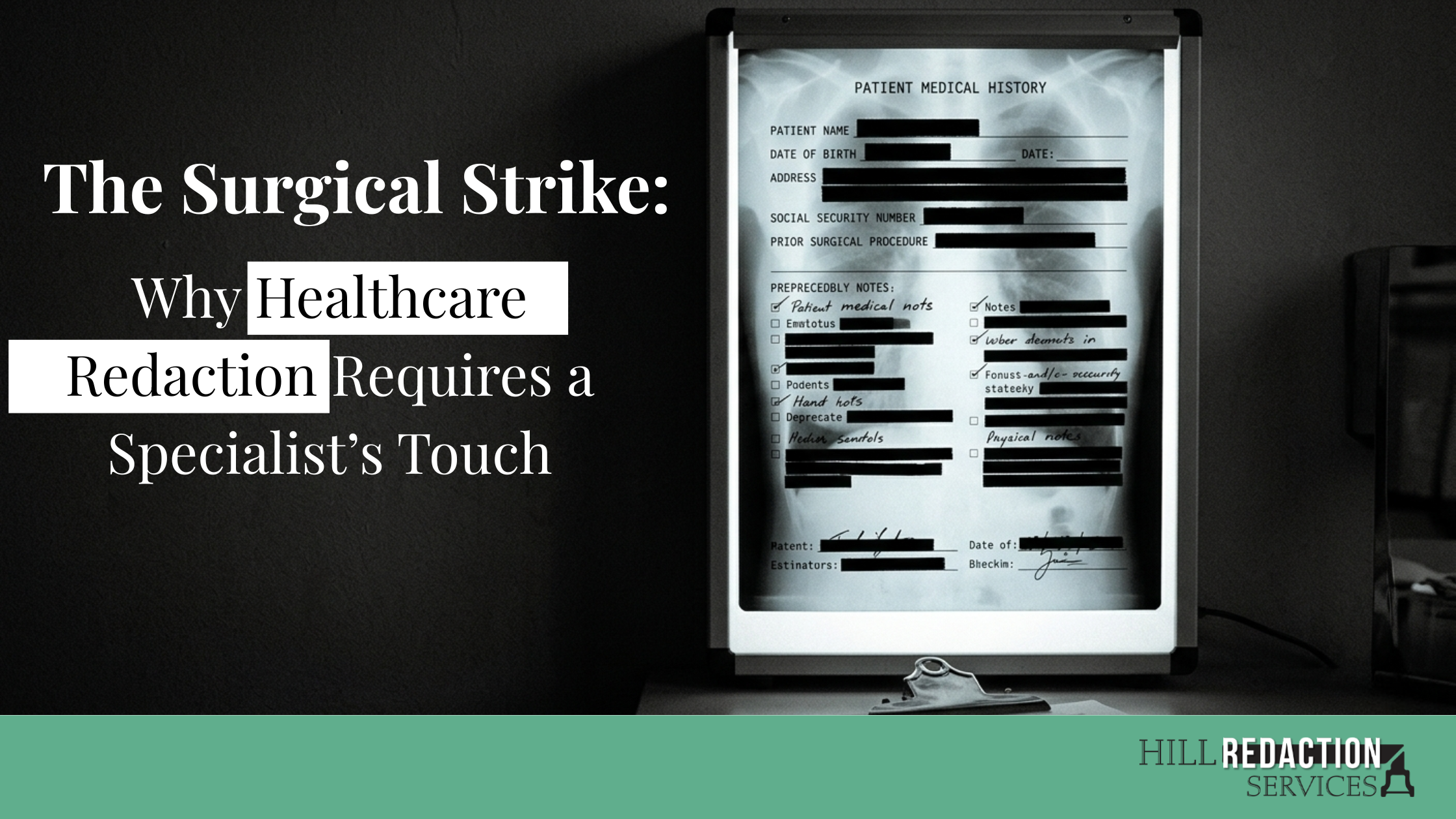
The Surgical Strike: Why Healthcare Redaction Requires a Specialist’s Touch
In a hospital, a millimeter is the difference between a successful procedure and a critical failure. Precision is the baseline. We expect it in the OR, we demand it in the lab, and we rely on it in the pharmacy.
Yet, when it comes to the movement of Protected Health Information (PHI), many organizations still rely on “digital band-aids.”
The Diagnostic Gap
Hospitals are high-volume data factories. Between clinical trial submissions to the #EMA, legal discovery for malpractice defense, and medical record reviews for billing, thousands of pages leave the facility every day.
The risk isn’t just the text you see; it’s the “Digital Complications” hidden beneath the surface:
-
Metadata Ghosts: The hidden history of who edited the file and what was “covered” but not deleted.
-
OCR Leaks: Text that is searchable by a computer even if a human eye can’t see it behind a black box.
-
Contextual Identifiers: Information that, when combined with other public data, “re-identifies” a patient.
Redaction as a Clinical Procedure
At Hill Redaction Services, we don’t treat redaction as a clerical task. We treat it as a Surgical Strike.
-
Debridement of Risk: Just as a surgeon removes damaged tissue to save the patient, we scrub PII and PHI from the document’s foundation-not just the surface layer.
-
Maintaining Functional Integrity: The goal is a “clean” record that is still 100% usable for research or legal purposes. The data remains healthy; the identity is removed.
-
Sterilizing the Pipeline: By the time a document leaves our hands, it is “digitally sterile.” No breadcrumbs, no ghosts, and no path back to the patient’s private life.
The “Misallocation of Brilliance”
One of the greatest hidden costs in healthcare is the “In-House Drain.” When high-level legal counsel or clinical researchers spend hours manually drawing boxes on PDFs, it is a misallocation of their brilliance.
Specialized redaction allows your experts to stay in the OR and the courtroom, while we handle the microscopic precision of data security.
The Bottom Line
In 2026, a data breach is a wound that a hospital’s reputation may never fully recover from. Don’t trust your PHI to a generalist tool. Trust the specialists who understand that in healthcare, precision isn’t a preference- it’s a mandate.
Related Posts
The Surgical Strike: Why Healthcare Redaction Requires a Specialist’s Touch
In a hospital, a millimeter is the difference between a successful procedure and a critical failure. Precision is the baseline. We expect it in the OR, we demand it in the lab, and we rely on it in the pharmacy.
Yet, when it comes to the movement of Protected Health Information (PHI), many organizations still rely on “digital band-aids.”
The Diagnostic Gap
Hospitals are high-volume data factories. Between clinical trial submissions to the #EMA, legal discovery for malpractice defense, and medical record reviews for billing, thousands of pages leave the facility every day.
The risk isn’t just the text you see; it’s the “Digital Complications” hidden beneath the surface:
-
Metadata Ghosts: The hidden history of who edited the file and what was “covered” but not deleted.
-
OCR Leaks: Text that is searchable by a computer even if a human eye can’t see it behind a black box.
-
Contextual Identifiers: Information that, when combined with other public data, “re-identifies” a patient.
Redaction as a Clinical Procedure
At Hill Redaction Services, we don’t treat redaction as a clerical task. We treat it as a Surgical Strike.
-
Debridement of Risk: Just as a surgeon removes damaged tissue to save the patient, we scrub PII and PHI from the document’s foundation-not just the surface layer.
-
Maintaining Functional Integrity: The goal is a “clean” record that is still 100% usable for research or legal purposes. The data remains healthy; the identity is removed.
-
Sterilizing the Pipeline: By the time a document leaves our hands, it is “digitally sterile.” No breadcrumbs, no ghosts, and no path back to the patient’s private life.
The “Misallocation of Brilliance”
One of the greatest hidden costs in healthcare is the “In-House Drain.” When high-level legal counsel or clinical researchers spend hours manually drawing boxes on PDFs, it is a misallocation of their brilliance.
Specialized redaction allows your experts to stay in the OR and the courtroom, while we handle the microscopic precision of data security.
The Bottom Line
In 2026, a data breach is a wound that a hospital’s reputation may never fully recover from. Don’t trust your PHI to a generalist tool. Trust the specialists who understand that in healthcare, precision isn’t a preference- it’s a mandate.