As school districts and educational institutions prepare for the launch of a new academic year, administrative offices face a predictable late-summer surge: a wave of public records requests, FOIA filings, student transfer documentation, and state compliance audits.
Whether fulfilling requests for special education records, disciplinary logs, or district-wide administrative reports, school boards operate under strict federal guidelines-chief among them the Family Educational Rights and Privacy Act (FERPA) and HIPAA.
When public disclosures peak in August, district staff must balance statutory response timelines with zero-margin privacy laws. But in the rush to meet quick turnarounds, traditional document preparation methods leave educational entities severely exposed.
The Danger of Surface-Level Redaction in Education
Handling student records requires more than just making sensitive information invisible on a computer screen.
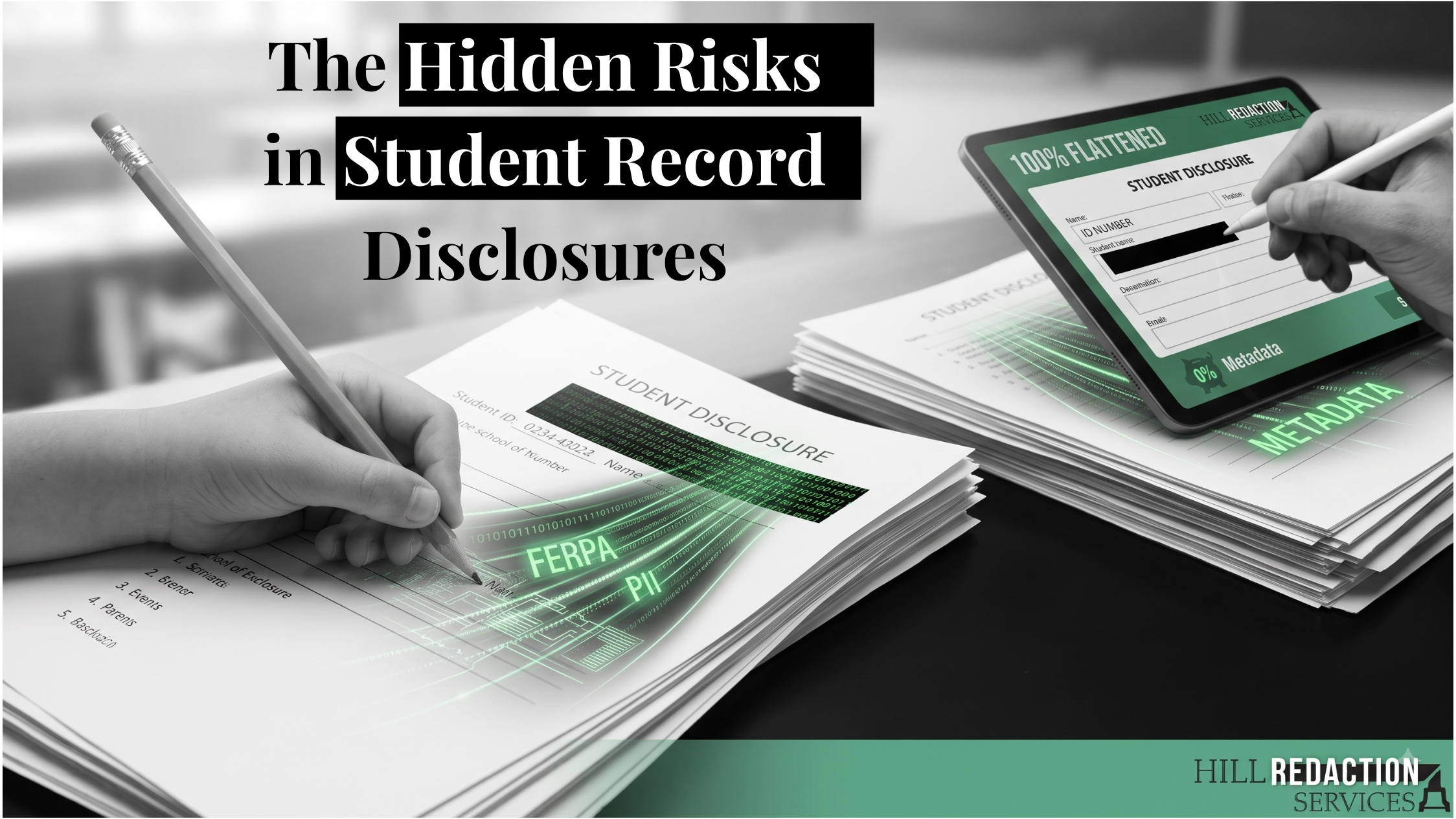
When administrative staff use basic PDF editors to draw black markup boxes over Personally Identifiable Information (PII)-such as student IDs, medical histories, behavioral notes, or parent details-they often create a false sense of security.
Underneath those visual black boxes, the file structure frequently retains:
- Hidden XML Metadata: Originating user profiles, internal file pathways, and school server tags.
- Recoverable Binary Text: Original data strings left intact beneath the visual overlay.
- Embedded Revision Histories: Previous edits and un-flattened notes accessible via simple digital tools.
In an environment governed by FERPA, releasing a file with recoverable student data isn’t an administrative oversight—it is a federal privacy violation that carries severe financial, legal, and reputational consequences.
The August Surge: Why Speed Increases Exposure
During peak disclosure windows, educational administrative teams are pushed to their limits. When forced to process hundreds or thousands of pages manually:
- Reviewer Fatigue Increases: Human reviewers miss subtle PII embedded within complex, multi-page student case files.
- Workflow Shortcuts Occur: Staff resort to quick “cosmetic” redactions to hit tight delivery deadlines.
- Liability Compounds: A single missed student record or un-stripped file layer turns a routine record release into a high-profile compliance breach.
To maintain FERPA compliance without crippling administrative speed, school districts must move away from manual “box-drawing” and adopt forensic-grade file de-identification.
Forensic File Flattening: The FERPA Standard
True compliance requires an audit-ready, structural approach to document preparation.
Forensic de-identification ensures that before any student record leaves the district environment:
- Sensitive Data Strings are Permanently Neutralized: Information is eradicated at the binary level, not merely covered on screen.
- Metadata is 100% Purged: All hidden file properties, author tags, and system trails are permanently stripped.
- Files are Completely Flattened: The document is converted into a single, un-recoverable layer that guarantees absolute privacy under regulatory scrutiny.
Protect Student Privacy Without Sacrificing Turnaround Time
Fulfilling record requests under tight academic and legal deadlines shouldn’t force your district to choose between compliance fines and missed statutory dates.
With expert forensic de-identification and rush turn-times available, educational institutions can process high-volume student record releases rapidly-with complete certainty that student privacy remains fully protected.
Facing a backlog of urgent student record disclosures?
At Hill Redaction Services, our forensic de-identification workflow guarantees 100% metadata removal, total file flattening, and audit-ready FERPA compliance-even on rush, same-day requests.
Schedule a Consultation with Hill Redaction Services Today.
Related Posts
As school districts and educational institutions prepare for the launch of a new academic year, administrative offices face a predictable late-summer surge: a wave of public records requests, FOIA filings, student transfer documentation, and state compliance audits.
Whether fulfilling requests for special education records, disciplinary logs, or district-wide administrative reports, school boards operate under strict federal guidelines-chief among them the Family Educational Rights and Privacy Act (FERPA) and HIPAA.
When public disclosures peak in August, district staff must balance statutory response timelines with zero-margin privacy laws. But in the rush to meet quick turnarounds, traditional document preparation methods leave educational entities severely exposed.
The Danger of Surface-Level Redaction in Education
Handling student records requires more than just making sensitive information invisible on a computer screen.
When administrative staff use basic PDF editors to draw black markup boxes over Personally Identifiable Information (PII)-such as student IDs, medical histories, behavioral notes, or parent details-they often create a false sense of security.
Underneath those visual black boxes, the file structure frequently retains:
- Hidden XML Metadata: Originating user profiles, internal file pathways, and school server tags.
- Recoverable Binary Text: Original data strings left intact beneath the visual overlay.
- Embedded Revision Histories: Previous edits and un-flattened notes accessible via simple digital tools.
In an environment governed by FERPA, releasing a file with recoverable student data isn’t an administrative oversight—it is a federal privacy violation that carries severe financial, legal, and reputational consequences.
The August Surge: Why Speed Increases Exposure
During peak disclosure windows, educational administrative teams are pushed to their limits. When forced to process hundreds or thousands of pages manually:
- Reviewer Fatigue Increases: Human reviewers miss subtle PII embedded within complex, multi-page student case files.
- Workflow Shortcuts Occur: Staff resort to quick “cosmetic” redactions to hit tight delivery deadlines.
- Liability Compounds: A single missed student record or un-stripped file layer turns a routine record release into a high-profile compliance breach.
To maintain FERPA compliance without crippling administrative speed, school districts must move away from manual “box-drawing” and adopt forensic-grade file de-identification.
Forensic File Flattening: The FERPA Standard
True compliance requires an audit-ready, structural approach to document preparation.
Forensic de-identification ensures that before any student record leaves the district environment:
- Sensitive Data Strings are Permanently Neutralized: Information is eradicated at the binary level, not merely covered on screen.
- Metadata is 100% Purged: All hidden file properties, author tags, and system trails are permanently stripped.
- Files are Completely Flattened: The document is converted into a single, un-recoverable layer that guarantees absolute privacy under regulatory scrutiny.
Protect Student Privacy Without Sacrificing Turnaround Time
Fulfilling record requests under tight academic and legal deadlines shouldn’t force your district to choose between compliance fines and missed statutory dates.
With expert forensic de-identification and rush turn-times available, educational institutions can process high-volume student record releases rapidly-with complete certainty that student privacy remains fully protected.
Facing a backlog of urgent student record disclosures?
At Hill Redaction Services, our forensic de-identification workflow guarantees 100% metadata removal, total file flattening, and audit-ready FERPA compliance-even on rush, same-day requests.
Schedule a Consultation with Hill Redaction Services Today.